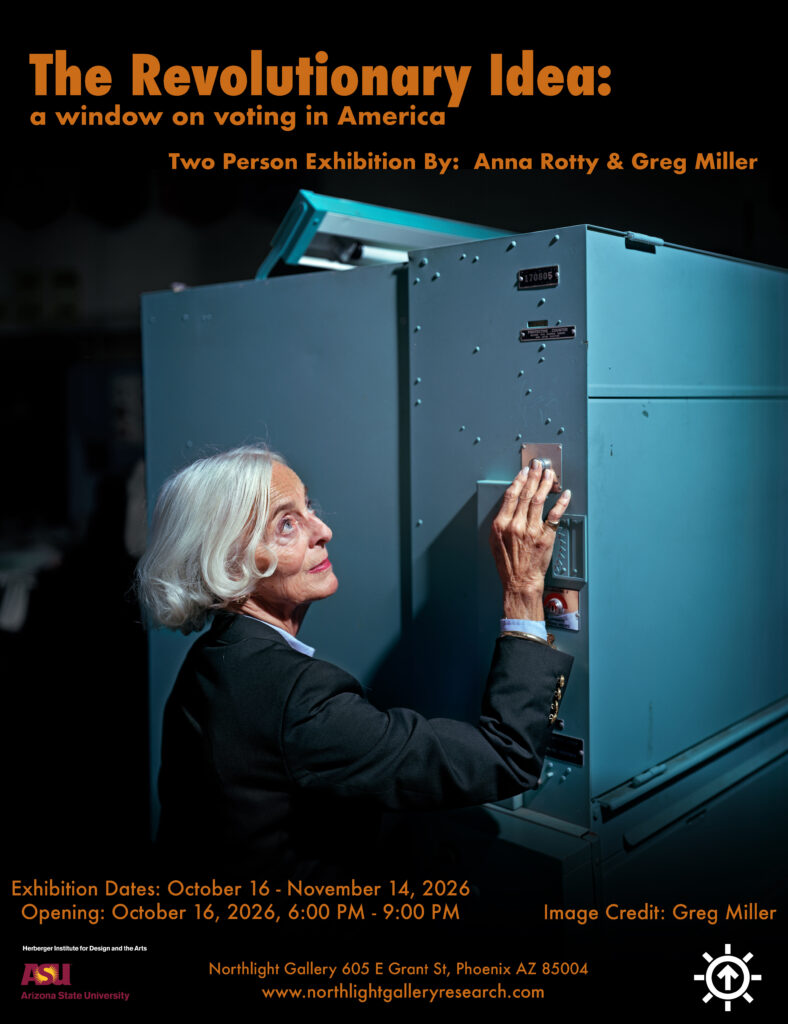
In Frederick Douglass’ 1852 speech, What to the Slave Is the Fourth of July? delivered 18 years before he had the right to vote, he reflects on the “revolutionary idea” of democracy as a bold vision that requires work to revise, expand and uphold. He paints a picture of the nation’s founders as they “lay deep, the cornerstone of the national super-structure”. A cornerstone is often beneath the surface, quietly supporting what rests upon it. In today’s world much attention is directed at politicians, but it is the backbone of the democratic process that is worth celebrating.
Anna Rotty and Greg Miller share a fascination with the vast array of individuals behind the peaceful transfer of power in the United States. Rotty’s work, which utilizes photography, audio, risograph printing and installation, grew out of her own service as a poll worker in 2016. Her photographs, and book made with Zach Clark of National Monument Press, along with audio interviews recorded with Angela Johnston, speak to the mosaic of communities making elections happen. Miller’s photographs, made with an 8×10 view camera, began as a magazine assignment to photograph polling stations during the 2004 presidential election. Miller discovered that our democracy is preserved by this simple, yet massive, system made up of individuals who care deeply about their own small part of it.
Through these experiences, the two see the people, the voters and poll workers as the foundation of democracy in this country. Not the candidates, not the results, but the ordinary people who show up, hand out ballots, and count votes by hand at the end of a long day. These people reflect a range of reasons for being there. Some step in for an elderly neighbor. Some translate for voters who need it. Some show up because they came from a country where this kind of election doesn’t exist at all. The polling place itself is just a room, a gym, a firehouse or a church basement, until the people inside it fill it with purpose.
Arizona, where this exhibition is held, as all other states in the country, rely on the work of individuals like the ones who appear in these photographs. Rotty and Miller see that Fredrick Douglass’ Revolutionary Idea has always depended on the honest, collaborative work of ordinary people upholding democracy.